Plutus
Plutus is the demonic warden of the Fourth Circle of Hell in Dante Alighieri's Inferno, a figure who embodies the monstrous guardianship of the circle where the avaricious and the prodigal are condemned to an eternity of futile labor. His appearance and his swift subjugation by Virgil mark a crucial moment in the descent, illustrating the power of divine authority to quell infernal resistance and reinforcing the structured hierarchy of punishment that defines Dante's underworld.
Identity and Role
Plutus is introduced in Canto VII as the guardian of the fourth chasm, a circle that punishes those who misused wealth through either hoarding or squandering. He is described as a "great enemy" and a "bloated lip," a monstrous figure whose very presence signals the nature of the sin punished within his domain. His role is not merely custodial; he is an active, hostile force that seeks to bar the entrance of the living Dante and his guide, Virgil. The text identifies him with a guttural, incomprehensible cry—"Pape Satan, Pape Satan, Aleppe!"—a phrase that underscores his alien and malevolent nature, setting him apart from the more articulate guardians encountered elsewhere in Hell.
Confrontation and Subjugation
When Dante and Virgil approach the descent into the Fourth Circle, Plutus immediately challenges them with his clucking voice. Virgil, described as the "benignant Sage, who all things knew," responds not with fear but with authoritative command. He silences the demon by invoking the higher power that sanctions their journey: "Be silent, thou accursed wolf; / Consume within thyself with thine own rage. / Not causeless is this journey to the abyss; / Thus is it willed on high, where Michael wrought / Vengeance upon the proud adultery." This invocation of divine will, referencing the Archangel Michael's defeat of Lucifer, causes Plutus to collapse instantly, his power deflated like a sail when the mast snaps. The demon's swift and total defeat demonstrates that no infernal force can withstand the authority of Heaven, a recurring theme in the Comedy where each guardian's resistance is overcome by the same formula.
The Punishment of the Avaricious and Prodigal
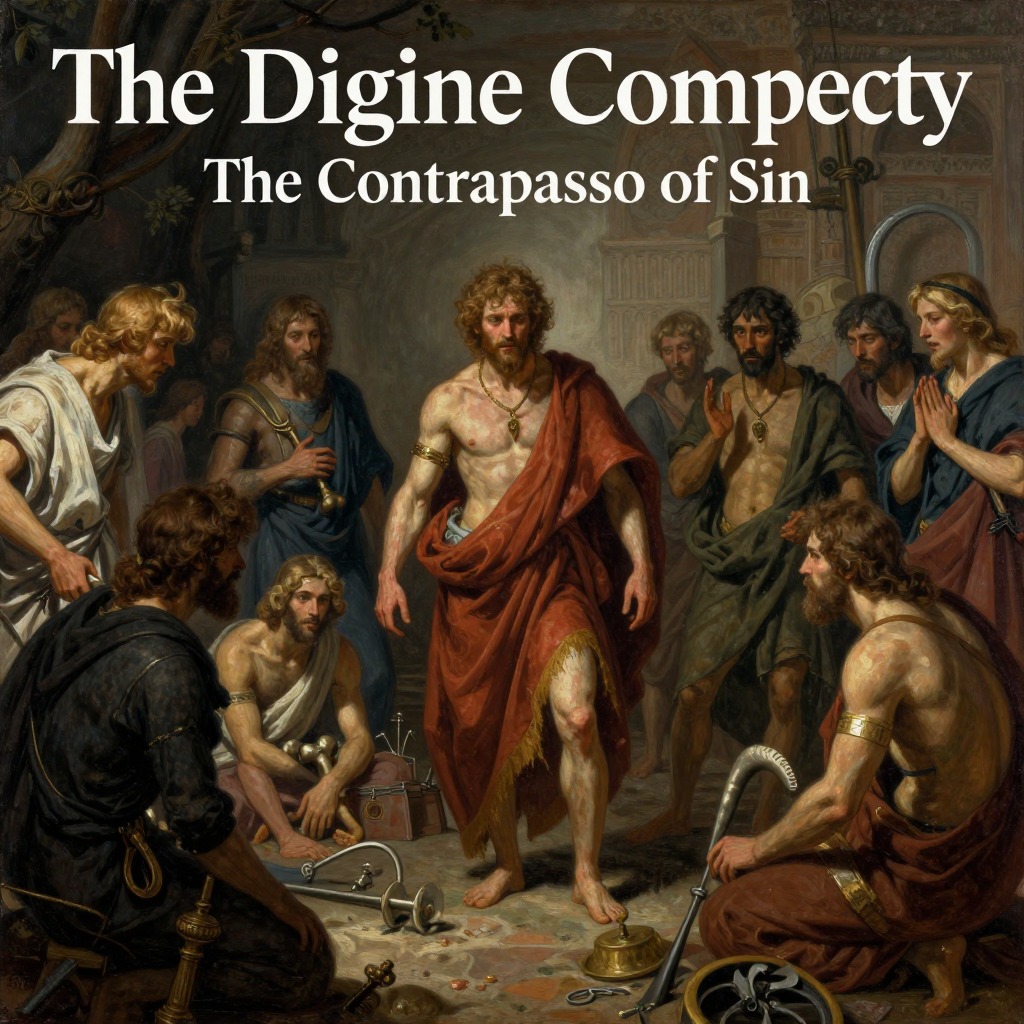
Once Plutus is subdued, Dante and Virgil descend into the Fourth Circle, where they witness the punishment over which he presides. The sinners are divided into two opposing groups: the avaricious, who hoarded wealth, and the prodigal, who squandered it. They are forced to roll enormous weights against each other in a ceaseless, circular joust, clashing together and then turning back to repeat the futile struggle. Their cries—"Why keepest?" and "Why squanderest thou?"—reveal the nature of their sin, a perversion of proper measure in the use of worldly goods. Virgil explains that many of these souls were once clerics, popes, and cardinals, whose avarice in life now renders them indistinguishable in their punishment. This scene, guarded by Plutus, serves as a vivid illustration of the contrapasso—the law of symbolic retribution—where the sin itself becomes the eternal torment.
Narrative and Thematic Significance
Plutus's role, though brief, is thematically significant. He represents the demonic embodiment of greed and the chaotic, self-destructive nature of avarice. His defeat by Virgil's words, rather than by physical force, emphasizes the power of divine justice and the ordained nature of Dante's journey. The episode also introduces Virgil's discourse on Fortune, which immediately follows Plutus's subjugation. This discourse, prompted by the sight of the avaricious and prodigal, explains Fortune as a divine minister who distributes worldly goods according to God's inscrutable will, a concept that directly counters the sinners' misguided attachment to wealth. Thus, Plutus serves as a gatekeeper not only to a circle of punishment but also to a deeper theological lesson about the proper relationship between humanity and material goods. His presence marks a transition from the sins of incontinence (lust, gluttony) to the more deliberate sins of malice and fraud, setting the stage for the increasingly severe torments of Lower Hell.